Now Reading: How Patois, Creole and Caribbean English Change From Island to Island
-
01
How Patois, Creole and Caribbean English Change From Island to Island


Ask someone to “describe” a Caribbean accent and you will usually get one flattened version. A little bit of Jamaica, a little bit of movie dialogue, maybe a phrase or two borrowed from a song.
The reality is far more layered.
Walk through Kingston, Port of Spain, Castries and Georgetown in the same week and you will hear four completely different rhythms, vocabularies and grammars, each shaped by its own history. None of them are “versions” of each other. They are their own languages and dialects, standing on their own.
One Region, Many Tongues
Jamaican Patois carries its own grammar system, its own tense structure and a vocabulary shaped by West African languages, English and the island’s own invention. It is spoken in homes, on the radio, in music, and increasingly in writing, from social media captions to published poetry.
Trinidad and Tobago’s Creole English leans on rhythm and intonation as much as vocabulary. A single word can shift meaning entirely depending on the stress placed on it, and the island’s Indian, French, Spanish and African influences all show up in the everyday phrases people use without a second thought.
St. Lucia and Dominica speak Kwéyòl, a French based Creole, a legacy of colonial rule that changed hands between France and Britain more than once. Kwéyòl is close enough to French that a French speaker might catch fragments, but distinct enough that it functions as its own full language, with its own literature and radio programming.
Guyana’s Creolese blends English with Dutch, Hindi, Indigenous and African language influences, shaped by the country’s unique position as the only English speaking nation on the South American mainland.
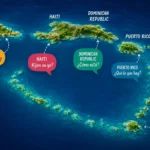
Haiti’s Kreyòl, one of the most widely spoken Creole languages in the world, has official status alongside French and carries its own rich body of literature, music and oral tradition.
And that is a fraction of the picture. Papiamento in Aruba, Bonaire and Curaçao. Sranan Tongo in Suriname. Antiguan and Bajan dialects with their own cadences. Each island’s history of colonisation, migration and trade produced a language shaped by that specific path, not a shared template.
Where the Language Lives
The clearest place to hear the difference is not in a classroom or a textbook. It is in daily life.
A market vendor negotiating a price. A grandmother calling a child in for dinner. A radio DJ hyping up a Friday night show. A group of friends breaking down a football match. A church service moving between formal English and something looser and warmer.
These are not performances of culture. They are just how people talk to each other. The language does not switch on for visitors or turn off when the cameras leave. It is the default setting of everyday life.
Code Switching Is a Daily Skill
For many Caribbean people, moving between Patois, Creole and standard English is not occasional. It is constant.
A conversation with a boss might run in formal English. The same person, five minutes later, calling a cousin, will slide into something entirely different, often without noticing the shift themselves. This ability to move fluidly between registers is a skill built from childhood, shaped by school systems that historically favoured standard English while home life ran in Creole or Patois.
That tension, between what was taught as “correct” and what was actually spoken at home, has shaped generations. It has also fuelled a growing movement across the region to recognise Creole languages as legitimate, structured languages in their own right, worthy of being taught, published and preserved rather than treated as a casual shortcut from “proper” English.
Language as Cultural Signature
Music has done more than almost anything else to carry Caribbean languages to a global audience. Dancehall carries Patois. Soca and chutney carry Trinidadian Creole cadences. Zouk carries Kwéyòl phrasing. Listeners across the world sing along to phrases long before they know what they mean, and that alone has quietly reshaped how Creole languages are perceived outside the region.
Within the Caribbean, language is also identity. The way someone speaks can signal which island they are from, sometimes which parish or district. It can shift depending on who they are speaking to, and it carries pride, humour, history and resistance all at once.
A Region That Sounds Like Itself
The Caribbean does not have one voice. It has dozens, each carrying its own grammar, its own history and its own reasons for existing exactly the way it does.
Understanding that is part of understanding the region itself. The language is not a colourful add on to the culture. In many ways, it is the culture, carried in the way people greet each other, argue, joke, pray and tell stories every single day.
To hear it spoken, really spoken, in a market, at a fete, on a porch in the evening, is to hear centuries of history still very much alive.
Related Posts


Stay Informed With the Latest & Most Important News
Previous Post
Next Post