Now Reading: Caribbean Media in Troubled Waters Due to AI
-
01
Caribbean Media in Troubled Waters Due to AI


-Klysha Best

The sun, sea, and sand may be timeless, but the business of telling the Caribbean’s story is facing its most turbulent chapter yet.
At the recent Caribbean Media Summit 2026, hosted by the Media Institute of the Caribbean, industry leaders delivered a sobering diagnosis: legacy media is fighting for its life.
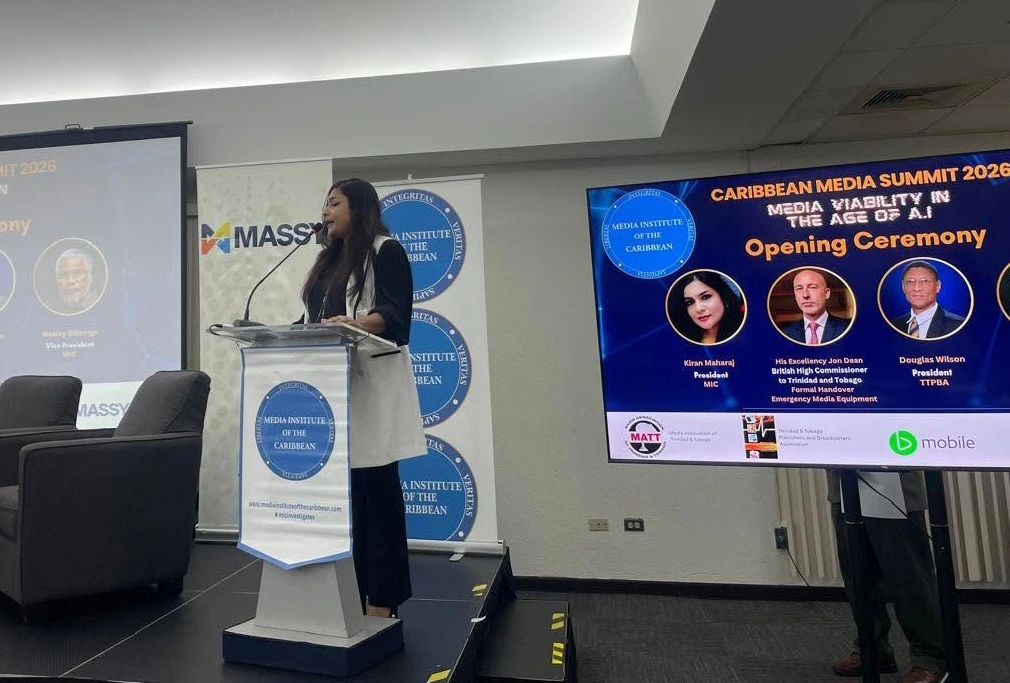
Advertising revenue is shrinking. Audiences have fled to TikTok and Instagram. And artificial intelligence is rewriting the rules of information. The question isn’t just whether newspapers and TV stations will survive, but who will tell the region’s stories when they don’t.
“The decline hasn’t been gradual,” said Douglas Wilson, president of the Trinidad and Tobago Publishers and Broadcasters Association. He pointed to COVID-19, then government policy decisions that sliced away “a huge swathe of revenue”.
Legacy media, he argued, is trapped in a vicious loop: costs are outdated, digital platforms deliver only 5-10% of needed revenue, and there’s no clear path forward.
“Your purpose doesn’t change,” Wilson stressed. “Where media fits in a democracy remains, if anything, it’s more important now. But we have to straddle that line.”
Jules Vasquez, news director of 7News Belize, laid blame on the tech giants. He described a media landscape saturated with clickbait “news pages” designed for “dopamine-crazed consumers.” Legacy outlets, he said, are cannibalising their own content for North American platforms to monetise, a new form of extraction that the Global South has endured for centuries.
“We line up and pay our credit cards so our children can have Netflix all day,” Vasquez said. “They’re extracting the money.”
However, Ivana Vucinic of the Global Forum for Media Development, said there is hope.
Vucinic pointed to investigative journalism networks across the Caribbean, collaborative infrastructure, and AI policy engagement as tools to lean on. “Collective leverage, long-term institutional thinking, shared capacity, that’s the way forward.”
For a region that depends on tourism, an industry built on perception, storytelling, and trust, the stakes couldn’t be higher. Who will capture the authentic Caribbean if its own newsrooms cannot afford to?
The survival of Caribbean media is not just a business problem. It is a matter of sovereignty, identity, and the right to be heard on our own terms.
Stay Informed With the Latest & Most Important News
Previous Post
Next Post