
Now Reading: Trinidad to Host Inaugural Caribbean EV & Hybrid Conference
-
01
Trinidad to Host Inaugural Caribbean EV & Hybrid Conference

By Klysha Best
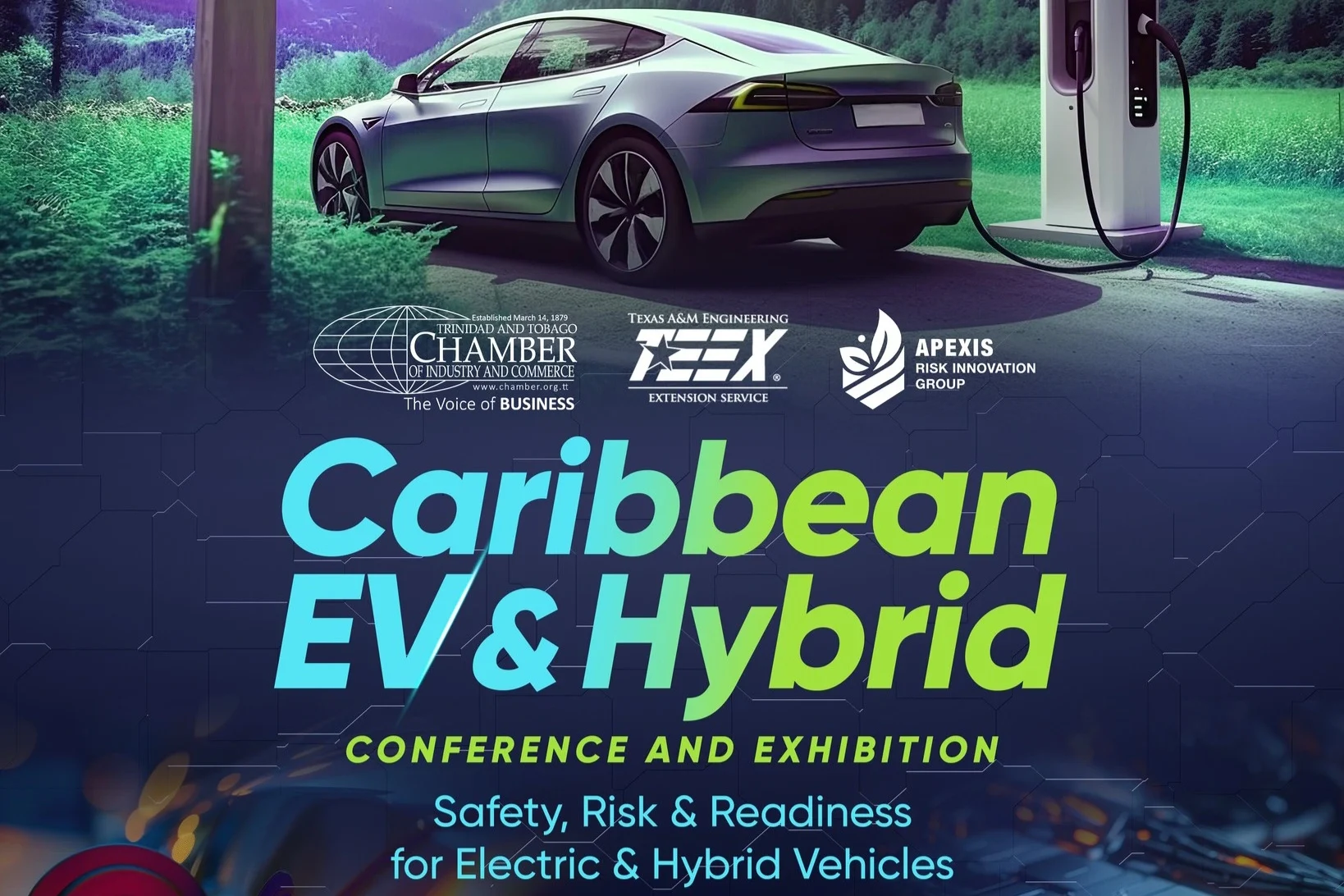
As electric vehicles become an increasingly common sight on roads across the Caribbean, a critical question lingers: are we ready for the risks that come with the revolution?
A new conference, the Caribbean EV & Hybrid Safety and Readiness Conference and Exhibition, aims to answer that question.
Scheduled for May 20, 2026, at the Trinidad and Tobago Chamber of Industry and Commerce headquarters in Westmoorings, the one-day event brings together a partnership: Apexis Risk Innovation Group, Texas A&M Engineering Extension Service (TEEX) and Trinidad and Tobago Chamber of Industry and Commerce.
“We recognised a gap in education around EV safety,” said Andrea Davis, CEO of Apexis Risk Innovation Group. “There are gaps on the regulatory side, the infrastructure side, and the entire ecosystem of EV. We felt it was important to bring the experts in.”
The conference is modelled on a similar annual event run by Texas A&M in the United States. This is the first time it has been brought to the Caribbean, and the focus this year is squarely on safety and readiness.
“When it comes to sustainability and EVs, a lot of things have to be considered, from the production of EVs right down to the disposal of batteries,” Davis explained.
The goal, she said, is not simply to promote electric vehicles, but to ensure that the entire ecosystem, from drivers and fleet operators to insurers, regulators, and first responders, understands the risks and responsibilities.
“If there is a serious incident involving EV vehicles, do we have the protocols? Do our emergency services know how to respond?” she asked. “We need to have these conversations now.”
Hilwyn Hernandez, Executive Director of Technology and Innovation at Apexis, noted that the number of EVs entering Trinidad and Tobago is growing rapidly.
“We have companies and dealers actively bringing in EVs. Very soon, our buses could be electric. Courier companies, fleet operators, they are all moving in that direction,” he said.
That shift brings new challenges: road infrastructure, battery temperature management, fire risks, and insurance underwriting. “The batteries are evolving. The type of batteries, their resilience, all these things are changing,” Davis added.
The conference will offer a practical, technical look at EVs, from infrastructure adjustments to the impact of tropical temperatures on battery performance. Attendees will also see the latest EV technology through an automotive partner showcase.
“You will get to see some of the newest EVs and have access to the people who know them best,” Davis said.
International experts will be present, including the Divisional Director of Texas A&M Engineering Extension Service. Interest has also come from Europe, the UK, and even Singapore.
“When international stakeholders hear about the conference, there is strong interest because the Caribbean is an emerging market that deserves more focused attention, dialogue, and practical support,” Hernandez said.
The organisers say the conference is ultimately about readiness, not alarm.
“This is about ensuring that as the region adopts EV and hybrid technologies, we do so with the right systems, awareness, and confidence in place,” noted Hernandez.
The conference is not a one-off. Hernandez already has his eyes on future editions, with hopes of taking the event to other Caribbean islands.
“As EVs and hybrid adoption grows, there is a clear need for greater coordination around standards, preparedness, and practical implementation. This conference creates space for that conversation to happen in a meaningful way,” according to Davis.
The Caribbean EV & Hybrid Safety and Readiness Conference and Exhibition takes place May 20, 2026, at the Trinidad and Tobago Chamber of Industry and Commerce, Westmoorings.
Registration details are available at www.electriccaribbean.com or call 1-868-637-6966 ext 1303

Related Posts



Stay Informed With the Latest & Most Important News
Previous Post
Next Post